Inside The Post

Choose an LED video wall when you need brightness, daylight visibility and a bold, high-impact image; choose projection when you need a very large image in a dark, controlled room on a tighter budget.
LED video walls are far brighter (they emit their own light), work in any lighting condition, and deliver richer colour and contrast — but they cost more per square metre. Projection can produce a huge image cheaply, but it needs a dark room, throw distance and a screen surface, and it washes out in ambient or natural light. For most modern corporate events, conferences and launches in variable lighting, LED is the better choice; projection still wins for large-format imagery in fully controlled, darkened environments.
This guide compares the two across every factor that matters, so you can hire the right display for your event. Not sure which fits your venue? Ask our team to recommend the right option.
Quick Comparison Table
| Factor | LED Video Wall | Projection |
|---|---|---|
| Brightness | Very high (self-emitting) | Depends on projector lumens; struggles in light |
| Works in daylight / ambient light | Yes | Poorly — needs a dark room |
| Image quality (colour & contrast) | Excellent, vivid, deep blacks | Good in the dark; washed out with ambient light |
| Max size | Modular — virtually unlimited | Very large images possible cheaply |
| Setup needs | Rigging/ground support, no throw distance | Throw distance + screen/surface + dark room |
| Cost | Higher per m² | Generally lower for large images |
| Best for | Corporate events, launches, outdoor, variable light | Cinema-style, dark rooms, huge low-cost images |
| Reliability of image on the day | Consistent regardless of light | Sensitive to ambient light changes |
What is an LED video wall?
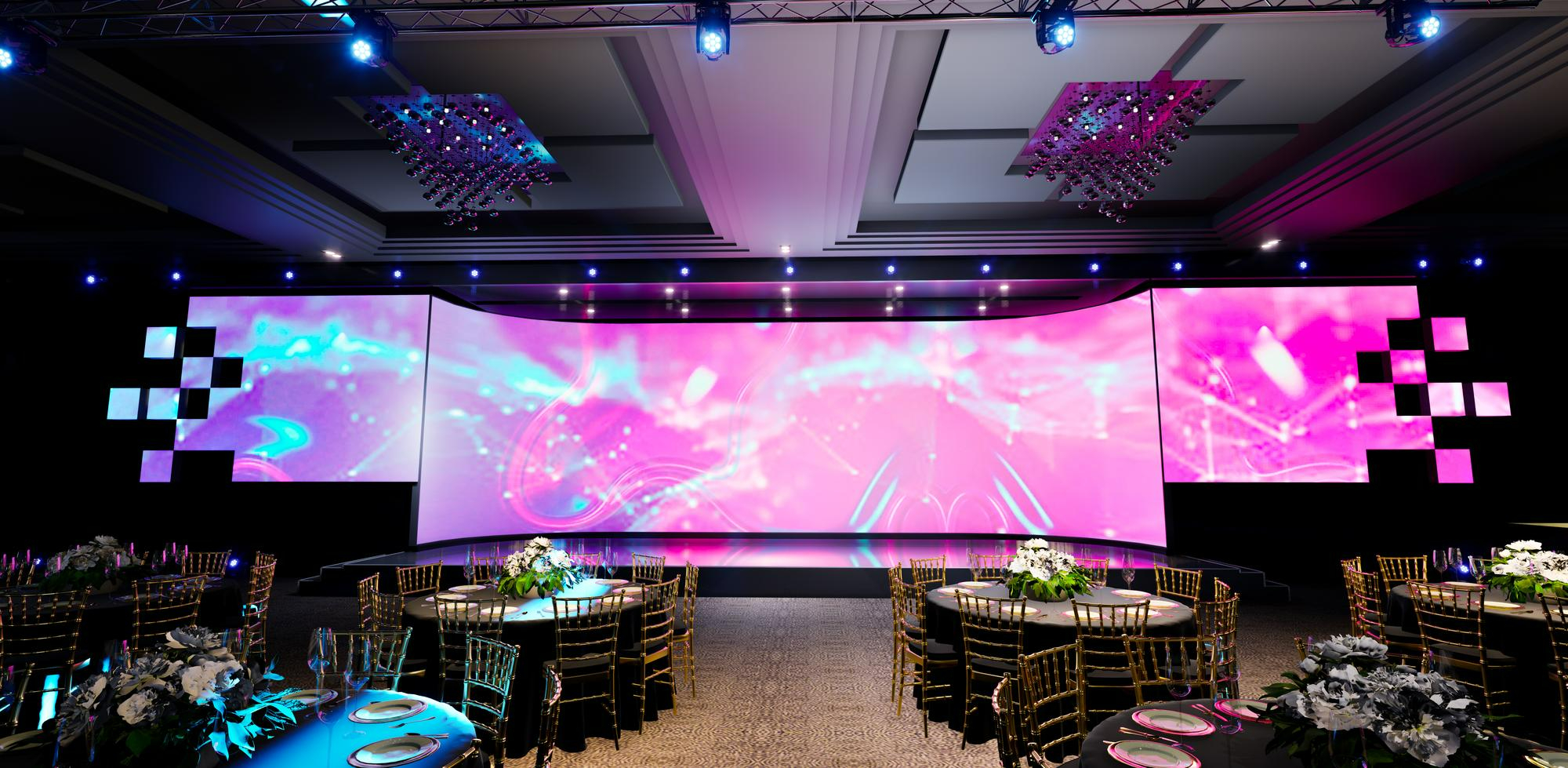
An LED video wall is a display built from modular LED panels tiled together to form a seamless screen of almost any size and shape. Each panel is made of thousands of tiny LEDs that emit their own light, so the wall is bright enough to be seen clearly even in daylight or a well-lit room.
Strengths
- Exceptional brightness — visible in daylight, ambient light and outdoors.
- Rich colour and contrast — deep blacks and vivid colour because each pixel produces its own light.
- Flexible size and shape — scale from a small screen to a full stage wall, including curved and creative configurations.
- No throw distance — the wall sits flat against a stage or structure, saving space.
- Consistent image — unaffected by changes in room lighting during the event.
Trade-offs
- Higher cost per square metre than projection.
- Requires rigging or ground support and appropriate power.
Resolution is set by pixel pitch — you choose the right pitch for your viewing distance (see our LED screen hire cost guide).
What is projection?
Projection uses a projector to cast an image onto a screen or surface. It's the traditional approach and still has a place, particularly for very large images in controlled environments.
Strengths
- Large images cheaply — a projector can fill a huge screen for a lower cost than an equivalent LED wall.
- Compact hardware — the projector itself is small; the "screen" can be a simple surface.
- Great in the dark — in a properly darkened room, modern projectors produce a beautiful image.
- Ideal for immersive/blended visuals — projection mapping and edge-blended wide images are a projection speciality.
Trade-offs
- Needs darkness — ambient or natural light washes the image out, reducing contrast and colour.
- Throw distance — the projector needs space between it and the screen (or a short-throw model and careful placement), which affects room layout.
- Screen surface required — plus sightline management so no one blocks the beam.
Contrast and black levels are limited compared with LED, especially in any ambient light.
Head-to-head: The Factors That Decide It
Brightness and Lighting Conditions
This is the single most important difference. LED emits light; projection reflects it. In a bright room, by a window, or outdoors, an LED wall stays crisp and vivid while a projected image fades toward grey. If your venue has any natural or house light you can't fully control, LED is the safer choice.
Image Quality
LED delivers deeper blacks, higher contrast and more saturated colour because each pixel is its own light source. Projection can look excellent in the dark, but its contrast and black levels drop as soon as ambient light rises.
Size and Shape
Projection makes very large images affordable. LED is modular, so it can be built to almost any size or shape — including curved, columns and creative forms — but cost rises with area.
Cost
For a large image in a dark room on a budget, projection often wins on price. For brightness, impact and reliability in variable light, LED delivers more value even at a higher price because the result is consistent.
Setup and Venue
Projection needs throw distance, a screen and clear sightlines; LED needs rigging or ground support and power but no throw distance, saving floor space. Venue constraints frequently decide the choice.
Reliability on the Day
An LED image looks the same whether the room lights are up for networking or down for a keynote. A projected image is at the mercy of the lighting — a common cause of "why does the screen look washed out?" moments.
When to choose an LED video wall
Choose LED if your event involves any of the following:
- A bright or partially lit room, windows, or outdoor
- A need for high impact and bold branding — launches, awards, activations.
- Daytime conferences or exhibitions where house lights stay up.
- Creative shapes — curved walls, columns, non-standard aspect ratios.
- Long viewing where consistent, fatigue-free image quality matters.
Explore LED video wall and screen hire.
When to choose projection
Choose projection if:
- You can fully darken the room.
- You need a very large image on a tight budget.
- You're doing projection mapping or immersive blended visuals across surfaces.
- The venue suits throw distance and a screen without sightline problems.
Can you use both?
Yes — and larger events often do. An LED wall might serve the main stage where impact and daylight visibility matter, while projection covers a large immersive side surface or a darkened breakout room. A full-service event production team can design a display strategy that uses each technology where it performs best, rather than forcing one solution across the whole event.
How to decide: a quick checklist
Ask these questions:
- How much light will the room have? Any ambient/natural light → LED.
- How big does the image need to be, and what's the budget? Very large + tight budget + dark room → projection.
- Indoor or outdoor? Outdoor → LED (weatherproof, high-brightness).
- What's the venue layout? No room for throw distance → LED. Plenty of depth and a dark room → projection is viable.
- How important is brand impact? High-impact, bold visuals → LED.
If you're unsure after this, a short consultation with an AV technician who knows your venue will settle it quickly.
Why hire your display from Mars Productions?
Whether LED, projection or both, the result depends on correct specification and skilled setup. Mars Productions designs and delivers the right display solution for your venue and audience across Melbourne (with support in Sydney), backed by:
- 10+ years of AV event production experience.
- 300+ events delivered each year.
- Over $1 million invested in current, professional-grade LED and projection equipment.
- End-to-end delivery — display, audio, lighting and staging from one accountable team, with technicians on site to run it.
We'll recommend the option that genuinely suits your event — not the most expensive one — and make sure it looks flawless from the first slide to the last.
frequently asked questions
For most modern events in variable or bright lighting, an LED video wall is better because it’s far brighter, works in daylight, and delivers richer colour and contrast. Projection is better only when you can fully darken the room and need a very large image on a tighter budget.
Yes, significantly. LED panels emit their own light and stay vivid in daylight and ambient light, while a projector reflects light off a screen and washes out as room brightness increases.
Often yes for a large image in a dark room, because a single projector can fill a big screen affordably. But LED usually delivers better value in any room with ambient light, since a projected image there looks washed out regardless of price.
Not effectively. Projection needs a dark, controlled environment; ambient or natural light drastically reduces contrast and colour. For rooms with windows or daytime events, choose an LED video wall.
Pixel pitch is the millimetre spacing between LEDs on a video wall and determines its resolution; a smaller number means higher resolution. Projection doesn’t use pixel pitch — its sharpness depends on the projector’s resolution and the image size.
No. LED walls are self-illuminating and look excellent in bright rooms, ambient light and outdoors, which is a key advantage over projection.
An LED video wall, using weatherproof, high-brightness panels that remain visible in daylight. Projection is generally unsuitable outdoors because it can’t compete with natural light.
Not necessarily. LED sits flat against a stage or structure with no throw distance, which can actually save floor space, whereas projection needs distance between the projector and screen plus clear sightlines.
Yes. Larger events often use an LED wall for the main stage and projection for large immersive surfaces or darkened rooms, letting each technology do what it does best.
LED generally films better because of its brightness, contrast and colour consistency, though it must be correctly configured to avoid on-camera flicker — an experienced technician handles this. Projection can look flat on camera in anything but a dark room.
Assess the room’s lighting, the image size and budget, indoor vs outdoor, and the venue layout. Any ambient light or an outdoor setting points to LED; a fully darkened room with space for a large, low-cost image can suit projection.
Yes. Mars Productions supplies and operates both LED video walls and projection across Melbourne and surrounding areas, and can design a combined solution where it suits the event.
Not sure which display suits your event?
Tell us about your venue, lighting and content, and our Melbourne team will recommend LED, projection or a combination — then deliver and run it.